
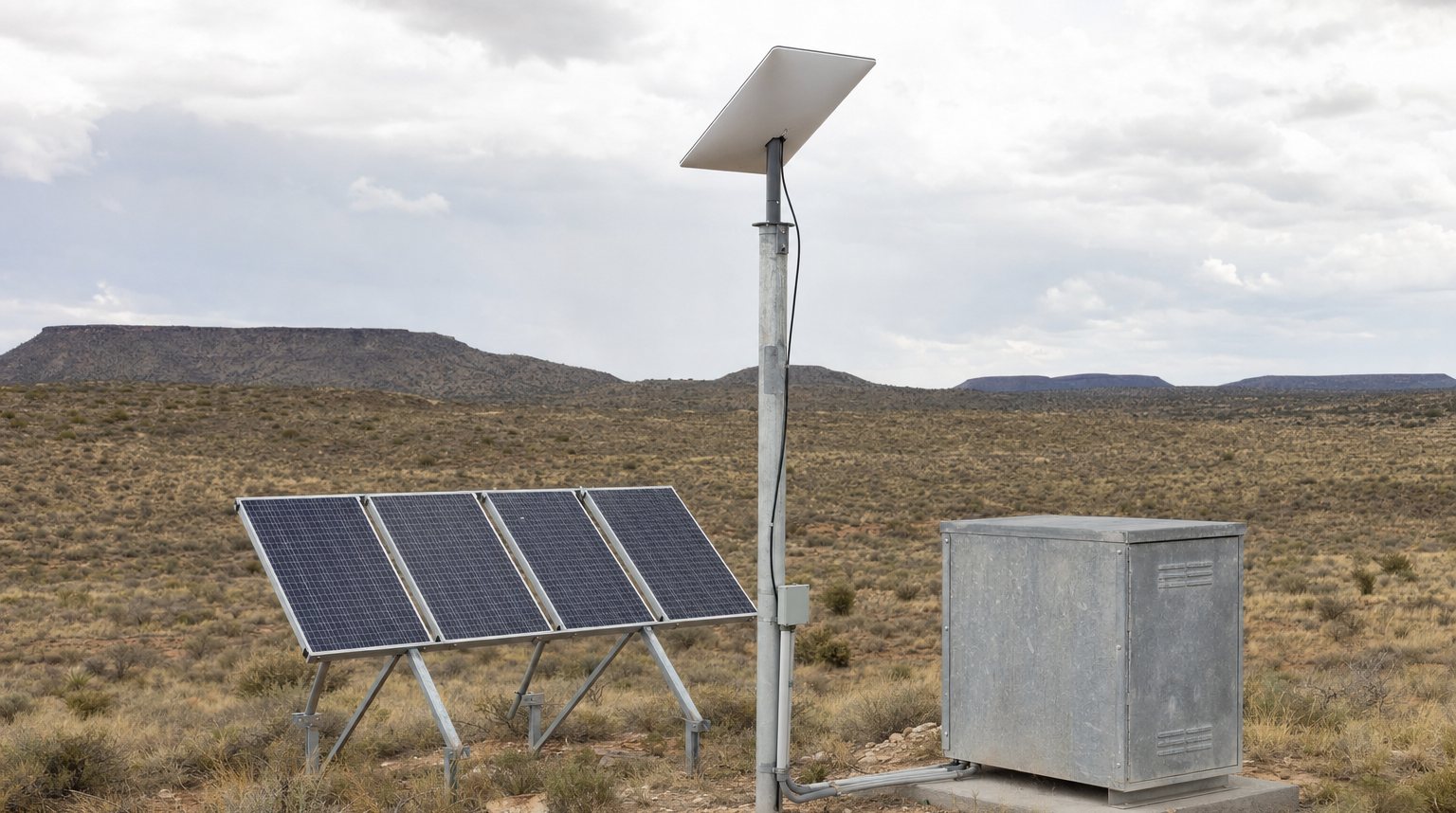
OneHow much power does a Starlink terminal use?
It depends on which one you have, and the two are very different.
| Terminal | Published average draw | Power input |
|---|---|---|
| Starlink Standard | 75 to 100 W | AC |
| Starlink Mini | 25 to 40 W | 12 to 48 V DC |
Always check which terminal is actually mounted. They draw different amounts and they take power differently. If you assume a site has a Mini and it really has a Standard, your number is off by about three times.
Walk the site or check the install record and write down which model is there. If you have more than one site, do this for all of them. You cannot size anything until you know.
TwoWhy does the Standard draw more from a battery bank than the spec sheet says?
The Standard runs on AC power. Your solar site runs on DC power. An inverter sits between them and converts one to the other.
An inverter in the path adds two costs:
- Conversion loss. Converting DC to AC wastes some power. Part of what leaves the battery never reaches the terminal.
- The inverter's own idle draw. The terminal runs all the time, so the inverter has to run all the time too. An inverter uses power just to stay switched on.
Both come out of your battery bank. Neither one is on the terminal's spec sheet.
How much they add depends on your inverter. There is no single number that is true for every site, so if a vendor quotes you one, they have not looked at your equipment.
Find the model number on your inverter and look up its idle or no-load draw in the manufacturer's datasheet. That number is specific to your site. Add it to the terminal's draw.
ThreeDoes the published wattage include snow melt heating?
No. SpaceX lists a snow melt capability for the Standard, rated to 40 mm per hour, and lists it separately from the average draw. It never says how many watts the heater uses.
So there is a number you cannot get from the spec sheet. You know what the terminal draws on an average day. You do not know what it draws on a day the heater is running.
The timing makes it worse. The heater runs in winter, which is when your array produces the least. An extra load you cannot measure shows up on the shortest, cloudiest days of the year.
Treat the published average as a good-weather number. If it snows at your site, your winter margin is smaller than your spreadsheet shows. Nobody has published how much smaller.
FourWhy does load creep go unnoticed?
Because nothing about adding a device makes anyone go back and re-check the power system.
A satellite terminal goes in to fix a communications problem. A camera goes in after a theft. A methane monitor goes in to meet a compliance deadline. Each one fixes the problem it was brought in for. None of them include a step that says check the array sizing again.
The Mini is easier to miss than the Standard. It takes 12 to 48 V DC, so it connects straight to the site bus with no inverter and no electrician. That is convenient, and it is why it often goes in without anyone checking the power system.
Two questions will tell you where you stand:
- What were your array and battery bank originally sized for?
- What has been added to that bus since?
Most operators cannot answer either one without digging through old records. That is not carelessness. It is that nobody owns the power system. The pumper is at the site constantly, but nothing in the lease operator job description covers solar arrays, charge controllers, or DC load (O*NET, Wellhead Pumpers and Gaugers, 53-7073).
Write down a load list: every device on the bus, with its draw. Most sites have never had one, and building it takes an afternoon.
FiveHow do you check whether your array still covers your load?
You do not need to buy anything for this. Your charge controller is already recording what you need.
Three checks, starting with the one that tells you the most:
- Battery voltage or state of charge at first light. This is the low point of the day, before the array starts putting anything back. Write it down every day for a month. If that low point drops week after week, your load is taking more than your array is putting back.
- How often the bank reaches a full charge. A bank that has not hit a full charge in weeks is running undercharged, and that shortens its life. Most controllers log this.
- Daily yield against your load list. Once you have the list from the section above, compare what the array produced against what the site used. Do this for your worst week, not an average one.
Pull the last 30 days off the controller and look at the first-light numbers. If they are flat, you have margin. If they are drifting down, you are using up your reserve.